
If you want a system that grows into every room of your house, Sonos is usually the better foundation. If you want a powerful, simple, one-room or one-TV experience with punchy, immediate sound, Bose often wins. Home theater buyers should look closer, though, because the gap between the Sonos Arc and Bose's Lifestyle Ultra soundbar comes down to specific models, not brand loyalty.
TL;DR:
- Both models are capable of supporting Dolby Atmos, but proper setup with supported HDMI connections and firmware updates are critical for optimal performance.
- Adding dedicated subwoofers like the Sonos Sub or Bose Lifestyle Ultra Subwoofer significantly improves low-end richness, often closing or reversing performance gaps observed in soundbar-only configurations.
- For multiroom and flexible integrations, Sonos offers deeper ecosystem expandability and control via its app, while Bose provides faster setup and easier out-of-the-box impact, especially in single-room scenarios.
- Model-level differences, such as the Sonos Arc Ultra or Bose Lifestyle Ultra Soundbar, often outweigh brand reputation when evaluating actual sound quality in home theater setups.
- Room acoustics, speaker placement, and proper calibration are more influential than brand choice in achieving high-quality sound, especially when paired with a subwoofer or Atmos-capable hardware.
Table of Contents
- Sonos vs Bose: The Real Trade-Off
- Shortlist: Top Sonos and Bose Picks by Buyer Job
- Sonos vs Bose: Feature-By-Feature Comparison
- How Do You Choose Between Sonos and Bose?
- Why Room Acoustics Matter More Than the Logo
- Getting Atmos and Multiroom Actually Working
- Streaming, Voice Control, and Multiroom Habits
- The Bottom Line on Sonos vs Bose
- What Happens When Something Breaks
- Build Quality and Design: What You'll Notice Day to Day
- Does It Play Nice With Your Other Smart Home Gear?
- Portable Options: Battery Life and Real-World Use
- Who Should Buy Which: Matching Speakers to Listening Habits
- How Smartsavvyhome Approaches This Comparison
- Where to Get More: SmartSavvyHome Tools and Reviews
- Sources
- FAQ
Sonos vs Bose: The Real Trade-Off
The decision isn't really Sonos versus Bose as companies. It's ecosystem flexibility versus curated simplicity. Sonos built its reputation on multiroom software that lets you group a soundbar in the living room with speakers in the kitchen and bedroom, all controlled from one app. Bose has historically leaned the other direction: fewer moving parts, faster setup, and a sound signature that hits you immediately without fiddling.
That framing holds up in independent listening tests, too. Sound experts who directly compared the two brands describe Sonos as balanced and natural, while Bose leans punchier with more forward bass and dialogue emphasis. Neither tuning is objectively correct. It depends on whether you want a soundbar that disappears into a mix or one that announces itself.
Where this gets complicated is at the high end. Bose's newer Lifestyle Ultra lineup was built specifically to compete with Sonos in multiroom and home theater, which signals Bose's more deliberate push into territory Sonos used to own outright. The old rule of thumb, Sonos for whole-home and Bose for one room, is less reliable than it was even two years ago.
Shortlist: Top Sonos and Bose Picks by Buyer Job
Skip the spec sheets and start with what you're actually trying to solve. Here's how the current lineups break down by use case.
- Best all-around home theater bar: The Sonos Arc delivers strong Dolby Atmos virtualization and slots directly into an existing Sonos system, while the Bose Smart Soundbar 900 counters with punchier out-of-the-box dialogue clarity and a wider soundstage for its size.
- Best if you want the newest Sonos hardware: The Sonos Arc Ultra adds improved bass and height-effect performance over the standard Arc, according to hands-on testing, though it inherited some of Sonos's ongoing software growing pains.
- Best Bose flagship for home theater: The Bose Lifestyle Ultra Soundbar (part of the broader Bose Smart Ultra family) pairs with the Lifestyle Ultra Speaker and subwoofer for a full room-filling setup built to rival Sonos multiroom systems.
- Best compact smart speaker, Sonos side: The Sonos Era 100 covers stereo basics affordably, while the Sonos Era 300 adds spatial audio support for Dolby Atmos Music.
- Best compact smart speaker, Bose side: The Bose Home Speaker 300 is built for plug-and-play, single-room listening with immediate presence rather than app-heavy setup.
- Best subwoofer additions: The Sonos Sub (Gen 3) and the Bose Lifestyle Ultra Subwoofer both exist to fix the same weakness: soundbars alone rarely deliver satisfying low end.
Prices span a wide range in the U.S. market, from budget compact speakers under typical entry-level price points to premium home theater bundles well above mid-range once you add a sub and rear speakers.
Sonos vs Bose: Feature-By-Feature Comparison
| Dimension | Sonos | Bose |
|---|---|---|
| Sound profile | Balanced, natural, neutral tuning | Punchier bass, forward dialogue |
| Best for | Multiroom households wanting one app for everything | Single-room or single-TV setups wanting instant impact |
| Expandability | Deep; add speakers, subs, and rears over time | Growing, especially with Lifestyle Ultra family |
| Smart features | Sonos app, Spotify Connect, AirPlay 2 | AirPlay, Google Cast, Spotify Connect, simpler app flow |
| Atmos / home theater | Sonos Arc, Arc Ultra, Beam Ultra all support Atmos | Smart Soundbar 900, Lifestyle Ultra Soundbar support Atmos |
| Setup ease | App-dependent; Trueplay tuning via phone | ADAPTiQ or app-based calibration, generally faster |
| Price range | Mid to premium across most categories | Mid to premium, similar range to Sonos |
The table tells only part of the story, though. Model-level choices frequently override brand-level generalizations. A standalone Sonos Arc, for instance, does not automatically beat a full Bose system. Measurement-backed testing found that a Bose Smart Soundbar 700 paired with matching speakers and a bass module outperformed a standalone Sonos Arc in soundstage width, tonal neutrality, and low bass. Compare complete systems, not just the centerpiece bar.
Statistic to know: RTINGS' side-by-side measurements consistently show that adding a dedicated sub and rear speakers to either brand closes or reverses whatever gap existed between the bare soundbars alone.
How Do You Choose Between Sonos and Bose?
Work through these questions in order before you spend a dollar.
- How big is the room, and what shape is it? Open floor plans favor wider dispersion bars like the Bose Smart Soundbar 900; boxier rooms benefit more from Atmos height virtualization like the Sonos Arc.
- Does your TV support HDMI eARC or only older ARC? Full Dolby Atmos passthrough on a Sonos Arc requires ARC or eARC over HDMI; an optical connection disables Atmos entirely.
- Will you expand later? If rear speakers or a second zone are likely within a year or two, Sonos's ecosystem depth generally pays off faster than Bose's.
- How much app fiddling will you tolerate? Sonos users trade some setup friction for long-term flexibility; Bose users trade some flexibility for faster out-of-box results.
- Are you willing to add a subwoofer? Skipping the sub is the single most common reason buyers feel underwhelmed by either brand's flagship bar.
At a retail demo, ask specifically how the bar handles dialogue at low volume, whether a second sub can be added later, and whether the model works in a multiroom group with other speakers you already own. Watch for red flags too: recurring app instability complaints, no Atmos passthrough on your existing TV, or a locked ecosystem that won't play nicely with speakers you already own.
Pro Tip: Bring your own streaming device or phone to any in-store demo. Showroom audio chains are often optimized in ways your living room setup won't replicate.
Why Room Acoustics Matter More Than the Logo
The brand-level generalization holds up in casual listening: Sonos tends toward a flatter, more natural response while Bose pushes bass and vocals forward for instant impact. But that's describing the bars alone, in isolation, in a controlled room.
Add a subwoofer and the calculus changes fast. A thin-sounding bar suddenly gains the low end it was missing, and the brand's "natural" or "punchy" signature becomes secondary to how well the sub blends in. This is why the Sonos Sub and Bose's Ultra Subwoofer exist. Neither company expects its flagship bar to carry full-range bass alone.
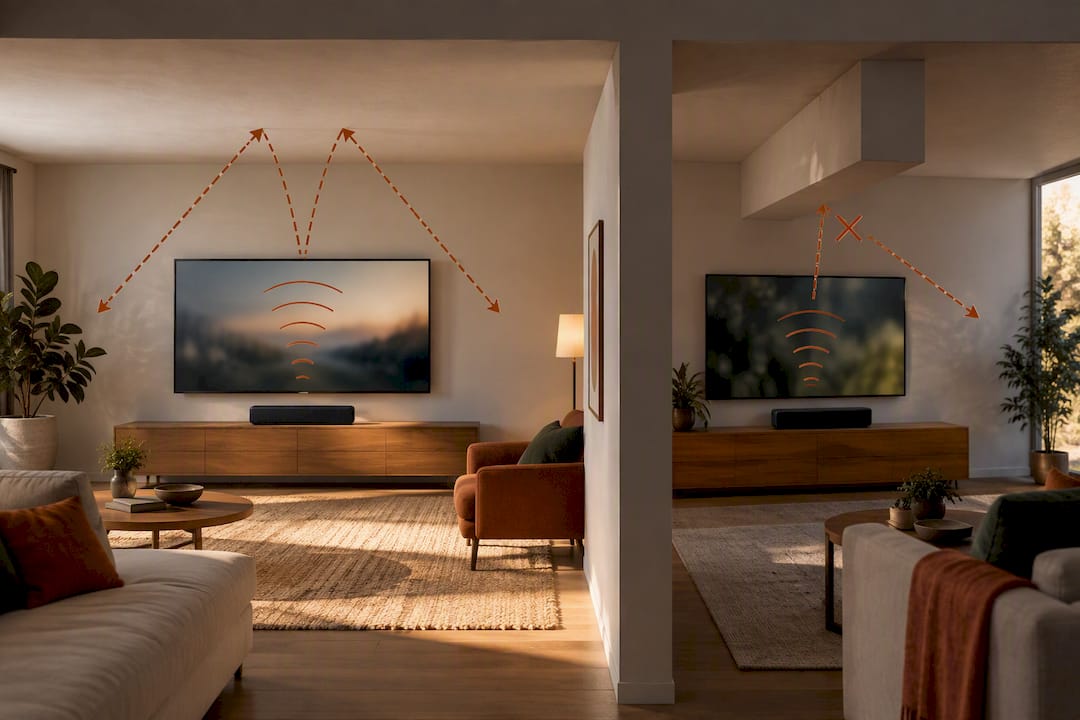
Dolby Atmos height effects follow a similar logic. Soundbar virtualization, bouncing sound off the ceiling, works best in rooms with flat, low-to-moderate ceilings and few obstructions. In awkward room geometries, virtualized height effects from either brand can underwhelm compared to dedicated up-firing or ceiling speakers. The Verge's Arc Ultra testing found real hardware gains in height-effect precision, but even improved hardware can't override poor room acoustics.
Getting Atmos and Multiroom Actually Working
Most "the soundbar sounds wrong" complaints trace back to setup, not the hardware itself. Start with your TV's audio output settings: confirm eARC is enabled and that the TV is set to pass a bitstream signal rather than downmixing to stereo. An optical cable will disable Atmos on a Sonos Arc entirely, regardless of how capable the bar is.
Run the phone-based room calibration, Trueplay on Sonos or ADAPTiQ-style tuning on Bose, after any furniture rearrangement, since both systems rely on room geometry and microphone-based calibration to tune the final sound. Skipping this step is the single most common reason buyers report a flat-sounding setup.
If Atmos isn't working:
- Confirm your TV outputs Dolby Digital Plus or Atmos bitstream, not just PCM.
- Check that the HDMI cable and port are both eARC-rated, not just ARC.
- Update soundbar firmware before troubleshooting further; both brands push regular audio fixes.
For multiroom sync issues, restart the app, confirm all speakers are on the same Wi-Fi band, and re-run the room grouping setup rather than assuming a hardware fault.
Streaming, Voice Control, and Multiroom Habits
Sonos multiroom grouping remains a genuine strength: its app lets you group and ungroup speakers on the fly, and Trueplay tuning adjusts sound per room. Reviewers have also flagged app reliability as an ongoing weak point, with software failures undermining otherwise strong hardware on the Arc Ultra.
Bose takes a more protocol-first approach on newer models, leaning on AirPlay, Google Cast, and Spotify Connect so you can cast directly from a phone without opening a dedicated Bose app. This matters if your household already mixes ecosystems. It's less convenient if you want tight, synchronized whole-home audio, where Sonos still has the edge.
The Bottom Line on Sonos vs Bose
Multiroom households: choose Sonos. Single-room or single-TV setups that want instant impact: choose Bose. Home theater buyers should audition the specific Sonos Arc or Arc Ultra against the Bose Lifestyle Ultra Soundbar or Smart Soundbar 900 with your own TV and streaming source, since model-level differences often outweigh brand reputation. Buy from a return-friendly retailer and confirm your TV's eARC support before you commit.
What Happens When Something Breaks
Sonos and Bose both offer standard one-year limited warranties on most speakers and soundbars in the U.S., with extended coverage sometimes available through the retailer rather than the manufacturer directly. Read the fine print before assuming a bundled sub or add-on speaker carries the same warranty term as the main unit. Some accessory components ship with shorter coverage windows.
Support channels differ in tone more than substance. Sonos leans on community forums and app-based diagnostics, useful for tracking down the kind of software glitches reviewers have flagged in newer models like the Arc Ultra. Bose tends to route more support through phone and chat with product specialists, which can feel faster for buyers who want a straight answer without digging through forum threads.
Neither company publishes dramatically better repair or replacement statistics than the other, so don't let warranty length alone tip your decision. What matters more in practice is how quickly firmware issues get patched. Both brands have shipped bars with early software hiccups that later firmware updates resolved. If you're buying a brand-new model in its first few months on the market, expect some rough edges regardless of logo, and register your product immediately so you're notified when patches or recalls arrive.
Keep your receipt and register the product through the manufacturer's site, not just the retailer's, since firmware-related service claims sometimes require that registration to move quickly.
Build Quality and Design: What You'll Notice Day to Day
Sonos speakers favor a minimalist, matte-finish aesthetic that blends into most living rooms without drawing attention. The build feels solid, with metal grilles on models like the Era 300 and a low-profile shape on the Arc that sits comfortably under most TVs without blocking the screen.
Bose products tend toward a slightly more rounded, consumer-electronics look, with the Home Speaker 300 and SoundTouch 10 favoring compact cylindrical or boxy shapes that prioritize desk or shelf placement over disappearing into a media console. The Lifestyle Ultra Soundbar and Smart Ultra Soundbar lean more premium in finish than Bose's older SoundTouch 300 generation, closing some of the design gap with Sonos.
Neither brand has a reputation for fragility, but placement matters for both. A soundbar mounted too close to a TV stand's edge or a compact speaker left in a humid bathroom will wear faster regardless of brand. If design consistency across a whole house matters to you, Sonos's more uniform product language across the Era, Arc, and Sub lineup makes mixed-room setups look more intentional than mixing Bose's SoundTouch and newer Ultra generations, which don't share the same visual identity.
Does It Play Nice With Your Other Smart Home Gear?
Sonos integrates with Amazon Alexa and, on select models, Sonos Voice Control, plus IFTTT-style automations through some third-party smart home platforms. It doesn't natively support Matter as of now, so buyers building a Matter-first smart home should confirm compatibility before assuming full integration.
Bose speakers generally support Amazon Alexa and Google Assistant depending on the model, with AirPlay and Google Cast support making it easier to fold a Bose speaker into an existing Apple or Google-centric smart home without extra hubs. That protocol-first approach is arguably Bose's biggest smart-home advantage: you're less locked into one voice assistant ecosystem.
Neither brand is deeply integrated with smart lighting or thermostat platforms the way a dedicated hub like Google Home or Amazon Echo is. Think of both as best-in-class audio systems that happen to accept basic smart home commands, not as smart home hubs themselves. If whole-house automation across lighting, locks, and audio matters more than pure sound quality, treat the speaker choice as separate from your hub decision rather than expecting either brand to anchor the whole system.
Portable Options: Battery Life and Real-World Use
Most of the products in this comparison are wired, AC-powered units meant to stay in one place, but each brand has one true portable answer worth knowing about. The Sonos Move 2 is Sonos's battery-powered option, built for moving between indoor rooms and the backyard, with Wi-Fi at home and Bluetooth for on-the-go use once you're outside your network's range.

Bose doesn't currently field a direct portable competitor in the same premium tier as the Move 2 within this comparison's lineup, which is worth noting if portability is a top priority. The rest of the Bose speakers covered here, including the Home Speaker 300 and SoundTouch models, are designed for stationary, plugged-in use rather than all-day battery operation.
If portability matters to you, the practical question isn't just battery hours. It's how the speaker sounds on battery power versus plugged in, since some portable speakers quietly limit output or bass extension to preserve battery life. Confirm real-world runtime expectations align with how you'll actually use the speaker, whether that's a few hours by the pool or an all-day backyard gathering, before assuming spec-sheet numbers translate directly to your routine.
Who Should Buy Which: Matching Speakers to Listening Habits
Casual, background listeners who want something that sounds good without fussing over settings tend to gravitate toward Bose. The Home Speaker 300 and SoundTouch 10 are built for exactly that: plug it in, connect Bluetooth or Wi-Fi, and start playing music without deep app configuration.
Buyers who care about precise, natural tonal balance, the kind of listener who notices when vocals sound artificially boosted, tend to prefer Sonos's flatter tuning, especially on the Era 300 with its spatial audio support for Dolby Atmos Music tracks.
Party or gathering use cases favor whichever system handles multiroom grouping most reliably at volume, which has traditionally been a Sonos strength given its mature grouping software, though Bose's Lifestyle Ultra family is closing that gap. Home theater enthusiasts chasing the most immersive Atmos experience should prioritize model over brand: the Sonos Arc Ultra and Bose Lifestyle Ultra Soundbar are both built for that exact job, and the better one depends on your TV, room shape, and whether you already own speakers from either ecosystem.
First-time smart speaker buyers with no existing ecosystem investment have the most freedom here. Start with the use case, not the logo, and let the shortlist above narrow things down from there.
How Smartsavvyhome Approaches This Comparison
Sound quality claims are only useful when they're tied to how a speaker performs in an actual living room, not a demo booth. This platform treats lab measurements and hands-on listening as complementary data points that need to align before a recommendation holds up, and directs readers toward full model reviews for the specifics relevant to their setup.
— Alphonso
Where to Get More: SmartSavvyHome Tools and Reviews
Comparing Sonos and Bose on spec sheets only gets you so far. What actually settles the decision is seeing how a specific model performs in a room shaped like yours, with the TV and streaming setup you already own.
That's the gap Smartsavvyhome exists to close. The site runs rigorous, independently reviewed buying guides and product comparisons across smart home audio, security, and automation categories, pairing measurement data with real-world listening notes so you're not choosing blind. Beyond speakers, Smartsavvyhome tracks pricing across retailers and curates setup walkthroughs for the exact eARC, Trueplay, and Atmos configuration questions raised above.
Before you buy, pull up the full model reviews and price tracking tools on the Smartsavvyhome homepage to confirm current deals and see how your shortlist stacks up against the latest lab results.
Sources
- Is Sonos vs Bose Better? Our Sound Expert's Verdict | Livingetc
- RTINGS — Sonos Arc vs Bose Smart Soundbar 700 with speakers & bass module
FAQ
Which Speakers Are Better Than Sonos?
No brand is universally "better," since Sonos's balanced tuning is a deliberate choice, not a weakness. Bose is the most direct competitor, offering punchier bass and simpler setup, and measurement testing shows a full Bose system with matching speakers and a sub can outperform a standalone Sonos Arc in specific metrics like low bass and soundstage width.
Why Is Sonos Stopping Support for Some Products?
Sonos periodically ends software updates for older "legacy" hardware as processors and memory become too limited to run current app features, a common practice across smart speaker brands, not unique to Sonos. Check a specific model's support status directly with Sonos before buying secondhand or older-generation hardware.
What Sound System Is Better Than Bose?
Sonos is the most commonly cited alternative, particularly for buyers who prioritize multiroom flexibility and a more neutral, natural sound profile over Bose's punchier presentation. The better system genuinely depends on room size, TV setup, and whether you value expandability over simplicity.
Is Sonos a High-End Brand?
Sonos sits in the premium mid-to-high tier of the smart speaker market, with pricing and build quality that compete directly with Bose's flagship lineup rather than budget speaker brands. Its reputation rests more on software ecosystem depth and multiroom capability than on luxury positioning alone.
Do I Need a Subwoofer With Either Brand's Soundbar?
Not strictly, but both the Sonos Arc and Bose's flagship bars sound noticeably thinner in low bass without one. Adding a dedicated sub, the Sonos Sub or Bose's Lifestyle Ultra Subwoofer, is the single change most likely to improve either system's real-world sound.